
Experts will give their inputs for Budget.

'My immediate objective is to start thinking about research once again. Start understanding the world we are in which has changed quite a bit.'

When it comes to running between the wickets -- which is exactly what an FM and a governor do -- Jadeja always defers to Dhoni's larger judgement of the situation and the needs of the team, observes T C A Srinivasa-Raghavan.

"I would hope that the government would very respectfully request him to continue for one term or my preference would be two terms," Narayana Murthy said.

Based on this screening, the committee may weed out applications that do not meet the eligibility yardstick or the 'fit and proper' criteria for securing a licence.

The idea of weaponization got a fillip from an unexpected quarter. In the last week of October 1985, Rajiv met US President Ronald Reagan. Reagan told Rajiv, 'Pakistan has already made a bomb.' When Rajiv started talking about disarmament, the US president cut him short, 'Don't talk theory, think of your own protection.'

Jayshree P Upadhyay ' Mumbai September 9, 2014 Last Updated at 22:50 IST Top Stocks to Buy in 2014 8-10 Best Stocks for 2014 per month Highly Accurate Calls, Free Trial stockaxis.com/Stocks-to-buy-in-2014 Ads by Google 3 Add to My Page RELATED NEWS Foreign investor cap in bourses may be raised Sebi sets foreign portfolio investor limit of 10% per firm Sebi move on FPI regime grounded No clarity yet on FPI regime Jaimini Bhagwati: Correcting tax and disclosure anomalies Karbonn Titanium S5 Plus Be 1st to own latest Android phone with Dual SIM, 8 MP Camera & more!www.karbonnmobiles.com/S5_Plus 1Cr Life Cover @ Rs 543* Compare Premium of 46 Insurers Buy Online and save upto 55%www.policybazaar.com/TermInsur_Rate Ads by Google In a move that could increase the stake of foreign investors in Indian stock exchanges, the government is considering a threefold increase in the single-investor investment ceiling. Currently,a foreign portfolio investor (FPI) investment in an exchange is capped at five per cent. The finance ministry has written to the regulatory authorities to increase the ceiling to 15 per cent, said sources. The proposal is said to have in-principle approval from the Securities and Exchange Board of India (Sebi) and the Reserve Bank of India (RBI). The move would bring the FPI investment limit in line with those for financial institutions such as insurance companies and banks. NEW POLICY IN THE WORKS Single foreign investor limit in exchanges to be revised from 5% to 15% Sebi and RBI have given in-principle approval to the proposal Government to amend foreign investment policy BSE has 8 foreign shareholders holding 31% stake NSE has close to 20 foreign shareholders holding 36% stake The government allowed the foreign investors to invest in stock exchanges in 2006, with an overall cap of 49 per cent. This latter cap is likely to be unchanged. BSE and the National Stock Exchange (NSE), the two large nationwide bourses, are likely to benefit from the increase in limits. BSE has eight foreign investors, which cumulatively own about 31 per cent in it. The shareholding of Deutsche Boerse Group and Singapore Exchange Ltd are a little below the five per cent ceiling. NSE has about 20 foreign shareholders, holding around 36 per cent. Cyprus' Gagil and Goldman Sachs own five per cent each; Citi Group has around two per cent. "The finance ministry has received representations stating that the present limit of five per cent is a deterrent in attracting long-term anchor and strategic foreign investors in stock exchanges. Following which, the ministry has sought comments from both Sebi and RBI," said a person privy to the matter. A higher foreign investor limit will not only encourage more investment in Indian bourses but help in exchange of technology and products, said exchange officials. "A five per cent limit on the shareholding of any single investor or investor group is too small to encourage them to take sufficient interest in growth of the exchange," said an official associated with one, asking not to be named. The regulator and the government are also mulling a change in the shareholding of clearing corporations, which could also see individual foreign investors' cap being increased to 15 per cent. Some sections of the market believe that allowing a single FPI to own 15 per cent in a exchange could be detrimental to having a diversified shareholding. The Bimal Jalan committee, in the previous review of ownership and governance of stock exchanges in 2010, had debated whether there was a need to revise the cap. It was in favour of having an anchor investor, such as a bank or financial institution, which would own up to 24 per cent. Read more on: Fpi ' Sebi ' Rbi ' Nse ' Foreign Investor ' Singapore Exchange ' Finance Ministry Read More Investors vie for shares of stock exchanges Pick-up in sentiment, volumes boost bourses' unlisted shares HDFC Life Click2Protect+ Get Lump Sum + Monthly Income Benefit* @ Affordable Rate. Buy Now hdfclife.com/Click2ProtectPlus Retirement Calculator Plan Your Retirement Online in 2Min Calculate & Compare Premium Here! policybazaar.com/Retirement Ads by Google Advertisements Get a freedom to choose your own plan. Click here to know more... Data transforming the match-making business. click here Open a free Trading & Demat A/c with Sharekhan Leadership and Corporate Accountability-India. Click here Great fares to Europe from INR 54,000* Amsterdam. Click here Start Investing with the best Broker in india Important Facts about Infant Hearing Screening Gifting Solutions. Make easy & perfect! Find out what converged solutions can do for you. Smart Cloud Virtualized Server Recovery. Learn more. The perfect drive the perfect style. Book a test drive 3 Add to My Page Back to Top Quick Links Go LATEST NEWSAll NewsIn this section Ebola threatening Liberia's existence, minister warns IS threatens to assassinate Twitter employees Motherson Sumi, Eicher Motors, TVS Motor gain inclusion in F&O segment ABG, Bharati Shipyard rallies on hopes of government sops Pre-market: Five stocks to watch out for in trade today US manufacturing industry pushes India for free trade Dollar gains on Fed outlook, hurts shares Wall St ends lower as Apple shares fall post launch Ukraine ceasefire 'mostly holding': US Flipkart launches third private label Citron News you can use Rss icon Errors to avoid when filing returns What is Gratuity? What are NEFT and RTGS? Check your Income Tax Credit credit status form-26AS online Saving capital gain tax on sale of property Calculate tax on your house property income How to Check your EPF Balance & status online Featured Videos iPhone killers? The biggest threats to Apple's dominance video Jaguar takes the battle to BMW video The 5 biggest IPOs in U.S. history video Here is the next-gen spy plane... a blimp video MOST POPULARReadSharedCommented Supreme Court reserves order on coal block allocations Apple launches Watch, two iPhones & Apple Pay Guj rains: Hundreds evacuated in Vadodara, Army on stand-by Neel Mukherjee's book in Man Booker shortlist Mumbai airport keeps airlines guessing on Airbus A380 parking bay Market News A fourth of mutual fund equity assets concentrated in 10 stocks ICICI Bank, HDFC Bank, Infosys, SBI and L&T among fund managers' preferred bets Den Networks: Investing in new growth avenues Its tie-up with Snapdeal to launch a shopping TV channel looks like a win-win deal Sensex, Nifty retreat from record highs on profit taking The BSE Sensex and Nifty fell on Tuesday from their record highs in the previous session as investors chose to book profits in recent ... High agri imports under govt lens Dept of commerce seeks ideas to curb import dependence for supply of commodities, writes to sector bodies MCX hopes FTIL stake sale will conclude by month-end The exchange's clarification came in the wake of FMC rejecting its demand to allow approvals for contracts for the March quarter of 2015.

We have a government with an extremely weak economic team advising a PM who hardly pays attention to their thoughts, says Jayanta Roy.

The RBI was not party to the decision to demonetize 500 and 1,000-rupee notes, which was taken at the highest level of India's political leadership.

RBI wants periodic revision of the pensions for its retired employees.

The scrutiny is expected to be over this month itself.

Banerjee supported 'Nyay' (poverty alleviation scheme of Congress) and people of India rejected his ideology, the BJP leader said.

RBI policy surely cannot impact agflation, in any case.

Ahead of his government's first full year budget, Prime Minister Narendra Modi on Friday sought ideas from economists to attract investments, create jobs and finance infrastructure to put India back on high growth path.

RBI Governor Raghuram Rajan on Tuesday said the government will decide on extension of his tenure.

"I think the Governor has been doing a great job for the country and we would certainly see it as a very positive move if he were reappointed," Naushad Forbes, president, CII.
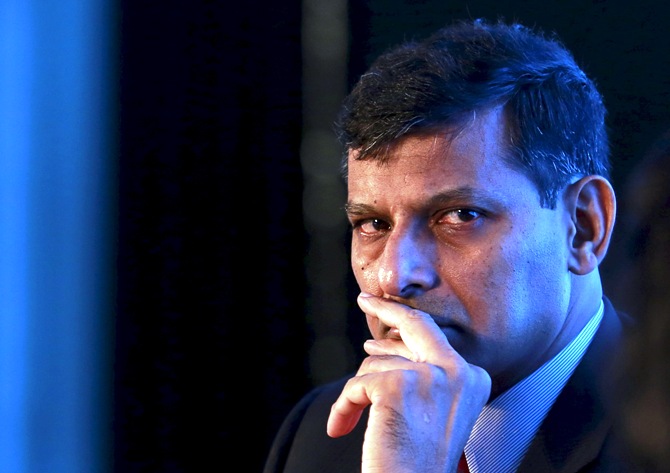
Centre to take a call only in August, just a month before his three-year term ends.

The central bank can directly print money and finance the government, but it should avoid doing so unless there is absolutely no alternative, former RBI governor D Subbarao on Wednesday said while pointing out that India is 'nowhere' near such a scenario. In an interview with PTI, Subbarao suggested that to deal with the second wave of COVID-19 induced slowdown in the economy, the government can consider Covid bonds as an option to raise borrowing, not in addition to budgeted borrowing, but as a part of that.

Raghuram Rajan has appointed him as head of several committees soon after taking charge.

The ones who came more recently were clutching the green cards that gave them an escape hatch through which to return to green pastures: Arvind Panagariya, Raghuram Rajan, Arvind Subramanian and other perfectly honourable gentlemen like them, points out T N Ninan.

Of the 40 CEOs polled from across the country, 60 per cent identified a fractured electoral mandate as a bigger risk than trade wars, volatile oil prices, and inflation.
The Centre's proposal to call for governance reform in the RBI could, however, take a back seat, a source privy to the development said.
Finance Secretary Hasmukh Adhia vacates his post on November 30 and Expenditure Secretary Ajay Narayan Jha, the second seniormost bureaucrat in the finance ministry, retires on January 31, the day before Jaitley presents the 2019-20 interim budget.

Today, with growth having slowed and macro-economic challenges in every direction, would the government have benefited from the advice of 'Harvard' economists? asks T N Ninan.

The additional cash will now give the Centre more headroom for stimulating the economy.

Exchanges have twin roles: commercial and regulatory.

Economists who get too close to prime ministers eventually come to grief after their boss is defeated
'His (Das) approach to work seems that of working as a team with ease in communication.'

For 2017-18 and 2018-19, investors are better off focusing on the quality of measures announced in the Budget and outside it rather than on the Budget numbers themselves, says T T Ram Mohan.

Pradhan Mantri Jan Dhan Yojana and Make in India -- are not covered here.

Refusing to link his seeking voluntary retirement, a year before his superannuation, to his transfer to the relatively low profile power ministry, he said that he had conveyed his decision to the Prime Minister's Office on July 18.

The government planned to borrow 10-15 per cent of the total borrowing offshore. That works out to at least Rs 71,000 crore, or about $10.4 billion at Friday's exchange rate.
EC received the RBI proposal in the first week of this month, soon after the model code of conduct came into force on March 5.

The RBI governor has to convert the zero-sum game with the government from a non-cooperative one -- which his two predecessors had made it -- to a cooperative one, explains T C A Srinivasa Raghavan.
Erstwhile RBI governors, including Raghuram Rajan never had cordial relations with the government.

T C A Srinivasa-Raghavan recalls a tussle between the government and RBI when Rajiv Gandhi was prime minister and how it was resolved.

In its essence, GST is a national level system of value added taxation of goods and services, says Shankar Acharya.
These changes will entail a relook at the various laws governing banks in the country - the two Bank Nationalisation Acts (passed in 1970 and 1980); the State Bank of India (SBI) Act of 1955; and the Companies Act of 2013.
It could be a matter of concern that foreign shareholders of the NSE are registered in tax havens such as Mauritius and Cyprus.
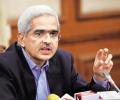
A staunch defender of demonetisation, it would be interesting to see how he handles the government's increasing demand for more cash from the RBI, and letting some weak banks get out of prompt corrective action.
